Australian birds
Preparing for Winter – The Rainbow Lorikeet
This is the quiet time of the year for the birds in our local nature reserve as they either migrate back to the warmer regions further north or just become […]
Welcome to our website for the study and appreciation of Australian birds and their interesting behaviours.
This is the quiet time of the year for the birds in our local nature reserve as they either migrate back to the warmer regions further north or just become […]
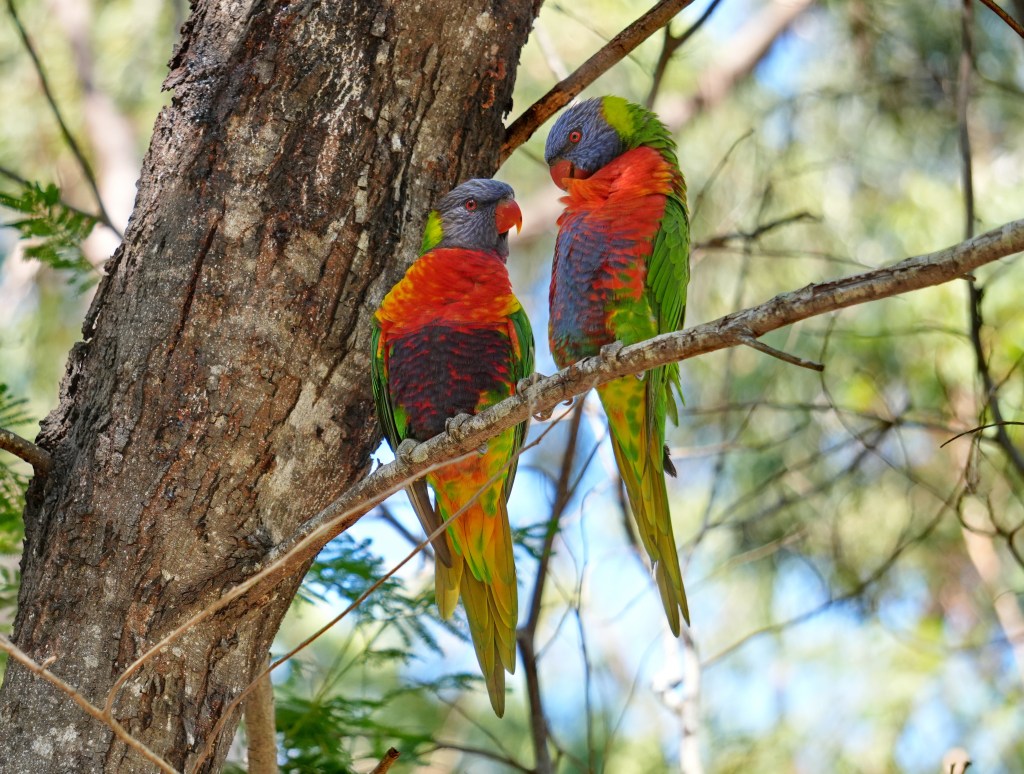
This is the quiet time of the year for the birds in our local nature reserve as they either migrate back to the warmer regions further north or just become quieter since they are out of their active exciting breeding seasons. However, some birds continue to breed into our winter months as it stays warmer now longer. This Rainbow Lorikeet pair I found as I was passing their tree hole and heard strange sounds of the them communicating quietly with each other. The female was inside the nesting hole while the male stood guard at the entrance. She would occasionally poke her head out for a look. When I later returned to show the nest to a new birder friend named Astrid whom I met on the track , the pair were sitting beside each other preening in the shade in direct view of the nest. There is frequently competition for nesting holes between Lorikeets, Cockatoo, Boobook Owls and Kookaburras in the park, but mainly between the first two.

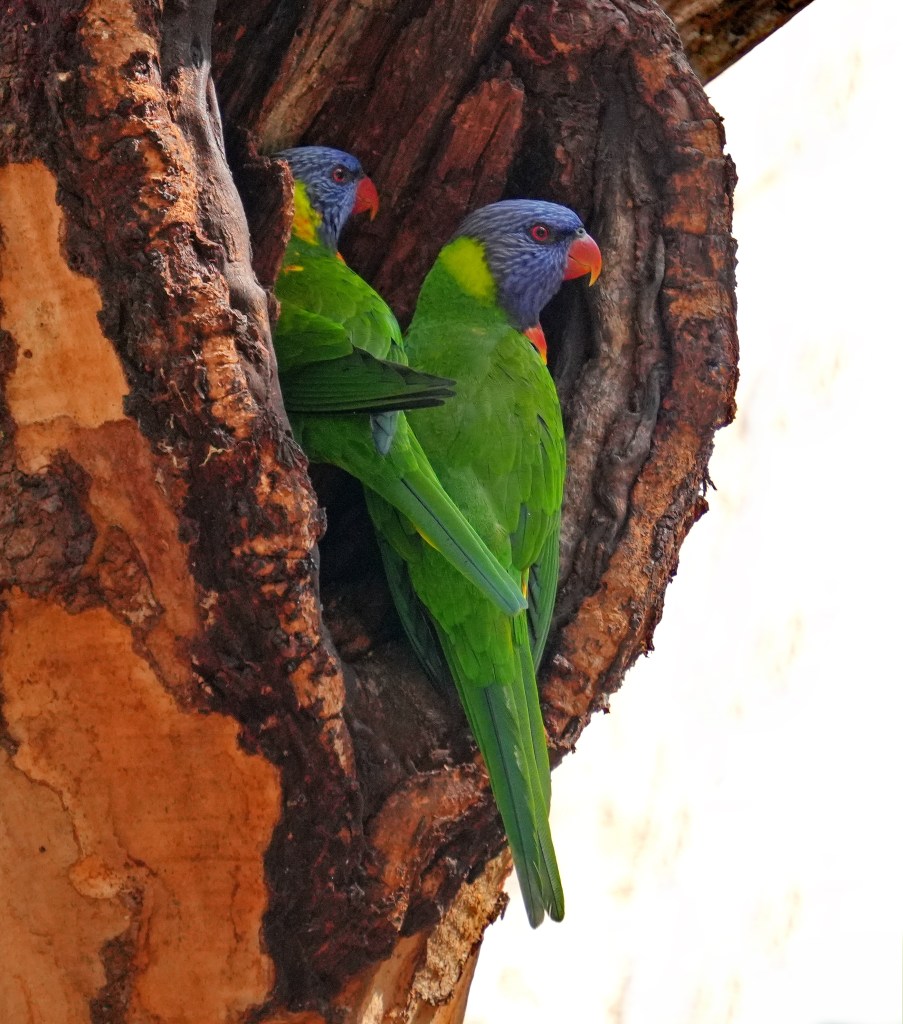

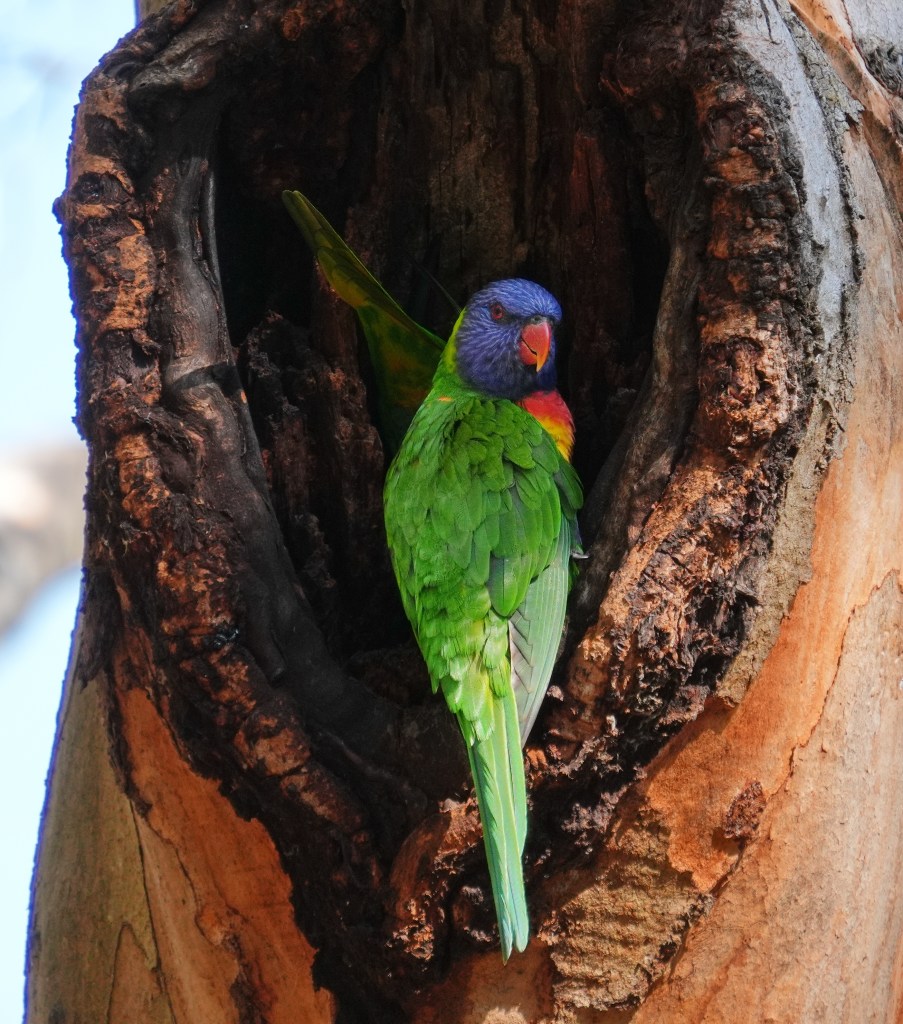
The female will sit on the eggs for about 23 days and the youngsters will fledge in about 54 days.

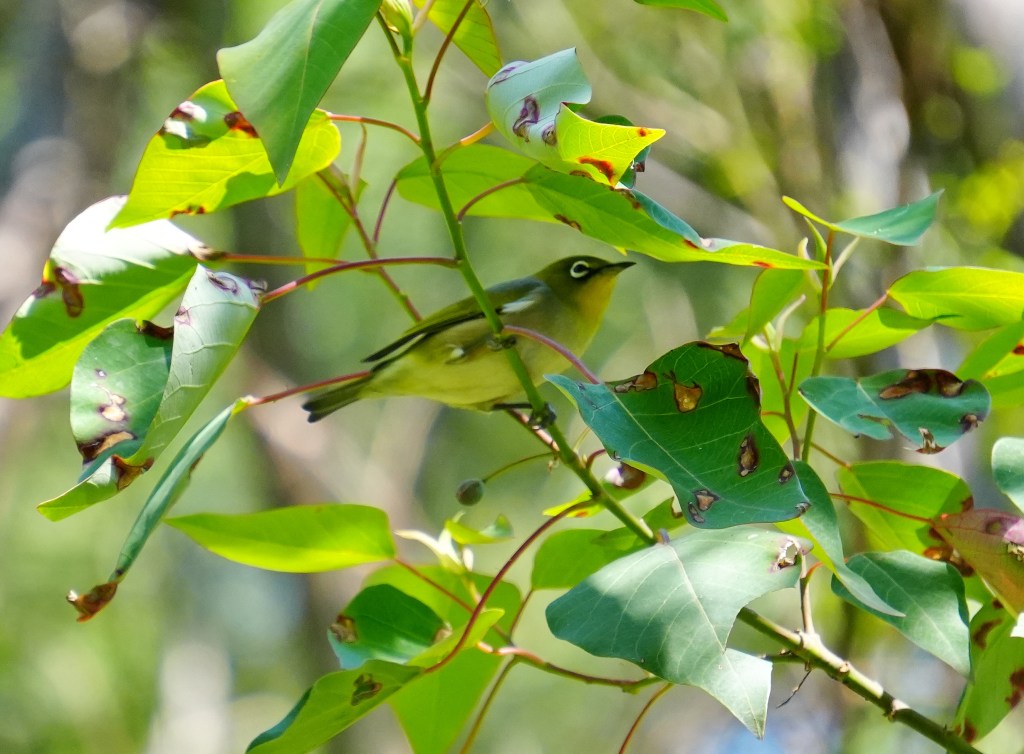
The Silvereye is a tiny bird also seen this time of year moving about the trees in search of insects and lerps, often with other small birds. When different species move about feeding together they are called MFF (Mixed Feeding Flock) This is common with small insectivorous birds. Lerps is a special food all tree birds (passerines) love as it gives them an energy sugar hit. The birds lick it off the back of eucalypt leaves . It is the white outer coating of the psyllid larvae of the sap-sucking insect that infects the leaves. Note the brown spots on the leaves in the images below, these are dead patches where the insect larvae were, which has killed parts of the leaf.

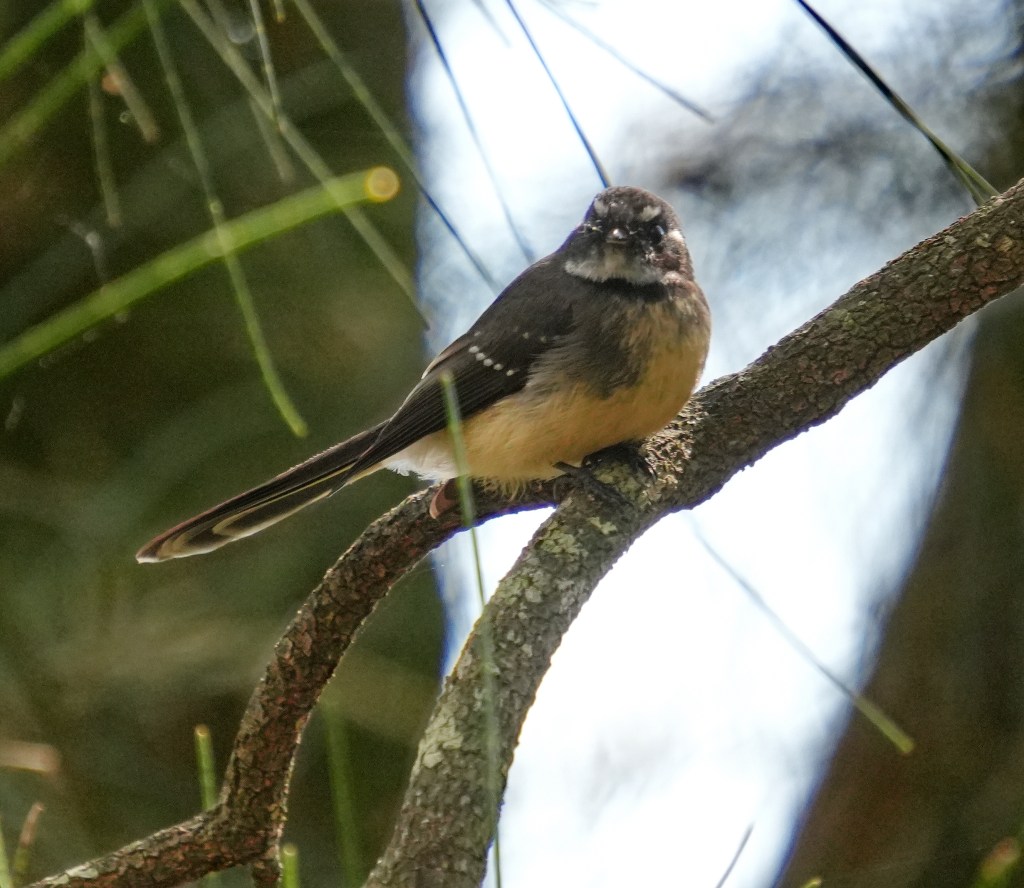
This Grey Fantail is another year round resident of our local nature reserve. It is a very bold little bird and will fly right up to you and check you out. Later it will follow you down the track a little way to see if you stir up any insects from the track, which it will rapidly fly down and catch. This little bird is classified among the flycatchers and fantails and are basically insectivorous, catching insects on the fly in a similar way to the Welcome Swallow.

The following territorial birds remain in our park all year round and breed here in spring to winter: The Rainbow Lorikeet, Sulphur-crested Cockatoo, Laughing Kookaburra, Australian Magpie, Brown Thornbill, Pied Currawong, White-browed Scrubwren, Red-browed Finch. These resident waterbirds also: The Australasian Swamphen. Dusky Moorhen, Chestnut Teal, Pacific Black Duck and Australasian Grebe.
The Rainbow Lorikeet is featured in my book ‘What Birds Teach Us’ which is available here online. Click the image below to find out more about the Beautiful Bird Book which not only features beautiful colour images of our popular Aussie birds and their interesting and clever behaviours, but each bird teaches a useful and helpful life skill (lesson) which makes it an excellent gift, especially to a Primary aged child or grandparent , to be read to younger children. It puts them in good stead to live a happy healthy life. The author, Aussiebirder, holds an Adv. Dip. in Counselling and Family Therapy as well as a working knowledge of the behaviours of many Australian birds. Click image to be directed to the Birdbooks page. It will open in a different tab.


Have a wonderful week. If you live in Australia and have seen a bird you have had trouble trying to identify. You can email me a pic of it or video clip. I often receive these requests. Though often the photos are not very good for identification. It is most important to get the face and head and describe where (town) and what sort of habitat you found it in.
When it becomes cold, windy and food sources diminish, especially insects, fruit and nectar, life is not so easy for those who stay behind for the Winter months. However, they manage and as my old friend says repeatedly: ‘Just get on with it !” We need to always continue to move forward in life regardless of what is placed in our path. Growth and experience and character are developed and honed through difficulty and adversity. It is when we get stuck in our grief, fear, doubt, anxiety or addictions, that we start to sink and stop moving forward to achieve and accomplish the growth to our wisdom and understanding which is such a vital blessing to our lives, not just for us but more so for our families and friends when we share our skills learnt with them. As I have shared in previous posts many of the great and famous achievements in history came as a result of resilient courage and faith in the face of momentary failures and disappointments to eventually achieve what was believed to be previously impossible. As one CEO is reported having overhanging his office seat for his employees to see:

As a result no one dared coming and saying: ‘I have a problem’, but they may say: ‘I have a challenge which I am proceeding to overcome can you assist me ? This is what I am planning to do ?’

Thomas Edison is a great example. He says: “I have not failed. I’ve just found 10,000 ways that won’t work,” Wisdom has the ability to learn from its mistakes and not to scorn them, for they are an important part of our growth and learning process. This wisdom we need to instruct our children and employees. It is alright to make mistakes as long as we learn from them a better way. It is an opportunity for us to share the better way with our children, but also allow them the freedom to make mistakes and learn from them.

This is a time of year for us to remember that Jesus, God’s dear Son suffered the Winter of the Soul for us, being accused and punished in our place. He pressed on in the face of great adversity performing the greatest act in history. He faced head on and alone the challenge of precuring the salvation and redemption of his people, those who would repent receive and believe in him to die to destroy the power of sin and pour out his life blood to atone fully for their sins (disobedient acts) so that all who believe in him would not perish but have eternal life, restored to the original loving relationship Almighty God originally intended for us all.


Adv. Dip. in Counselling and Family Therapy.
Member of Birdlife Australia
To introduce people to our unique Australian birds,
And learn from them how to live a healthy and happy life.
NOTE: All photos, videos and music used on this website are photographed, composed, performed by the site owner and remains his copyrighted property, unless otherwise stated. The use of any material that is not original material of the site owner is duly acknowledged as such. © W. A. Hewson 2015, 2016, 2017, 2018, 2019, 2020, 2021, 2022, 2023, 2024, 2025, 2026

My wife and I share a love of bird observing and bird photography which takes us all over Australia. We love sharing our experiences. Birds live in the beautiful parts of our country. We always get blessed with beautiful gifts of new birds and unexpected experiences each time we go out birding or just walking in the parks and reserves in our wonderful land. We love Australia, and the variety that each state and region offers in its wildlife and nature aspects. Join us in sharing our love. We have always found other birders enthusiastic and friendly people who appreciate the good things in life.
 Introduce your child to our amazing
and interesting birds.
Over 100 beautiful photos with
facts on how they do life, from
which we learn helpful life skills.
Click image above to Find out more and Buy the Beautiful Bird Book
Introduce your child to our amazing
and interesting birds.
Over 100 beautiful photos with
facts on how they do life, from
which we learn helpful life skills.
Click image above to Find out more and Buy the Beautiful Bird Book

Flight of a Fledgling similar to my first book uses the interesting lives of birds to teach valuable life skills.It is written expressly for teens and young adults as they prepare to leave the Nest. It helps them to better understand themselves and improve their personal relationships and better prepare for lifes challenges. Click on the above cover to find out more and purchase online.



 If you are a birder visiting the Sydney region for the first time, check out the many National Parks (NP) that surround it for the great variety of birds found there. The Visitor Information centres at The Royal NP, Botany Bay NP, Fitzroy Falls and Minnamurra NPs have information and also sell my Beautiful Bird Books. If you follow this blog, make a date with Aussiebirder before you arrive for info tips or a visit.
 aussiebirder
Awesome! I remember seeing these birds when I visited Australia. That’s a long time ago .. before I started bird photography.
LikeLiked by 1 person
Thanks Ruchira, so glad you are enjoying our birds still in my blog, and so good you got to see them when you were here.
LikeLike
Hello Ash,
I hope you and all your family are having a wonderful start to the week.
It was a joy to see this post with so many of the lovely birds I have come to recognize through your beautiful bird books and website☺️ I am happy to see images of the Silvereye which I know your wife loves. I also enjoyed learning the English birding term Mixed Feeding Flock (MFF) – we also observe the same phenomenon here in the winter months…our avian friends are very wise.
Have a blessed ahead dear friends!
LikeLiked by 1 person
Thanks Takami, always lovely to read your encouraging comments. You have remembered my wife loves the little Silvereye. It was very quiet when I took my grandson to our park yesterday for a picnic. The same Butcherbird that took my cheese months ago tried again and was training its youngster to do the same. Clever little critters. Joel will be returning home to day after a lovely stay. Our bird numbers are always low here this time of year, but lower then usual, though our weather is quite eratic.
LikeLiked by 1 person
I am always thrilled with your Rainbow Lorikeet shares, beautiful photos, Ashley! I hope you had a wonderful Easter celebration, we did here.
LikeLiked by 1 person
Thanks Donna, yes we did thanks Donna, we caught up with family we seldom see and currently have a grandson staying with us on Uni break catching some guitaring tips from his Pa 🙂
LikeLiked by 1 person
Have a fabulous time with your grandson! I’ve got one coming to stay with me in a couple days. 🥰
LikeLike
They’re beautiful birds, Ashley! What a blessing to see them.
Have a lovely Easter!
LikeLiked by 1 person
Thanks Deborah, have a blessed Easter weekend also, as we celebrate the wonderful accomplishments of our Lord Jesus 😊✝️
LikeLiked by 1 person
What beauties.
LikeLiked by 2 people
Thanks Cindy 🙂
LikeLike
Love your video of the rainbow lorikeet pair in their nesting hole. These birds are always fun to watch. Thanks for the information about the grey fantail. Now I know why these birds always fly around me on my walks and hikes. I thought they were just friendly little birds, but they’re just after food! 😂
LikeLiked by 2 people
Thanks Sue, yes the Fantails as well as the Willy Wagtail and even the Eastern Yellow Robin do similar as I think they have learned the art as birds are fast learners, and even learn from watching other local species.
LikeLiked by 2 people