This week we will focus on two of our most colourful multi-coloured birds found here in the Summer months, both very different in most aspects except their beautiful coloured plumage. […]
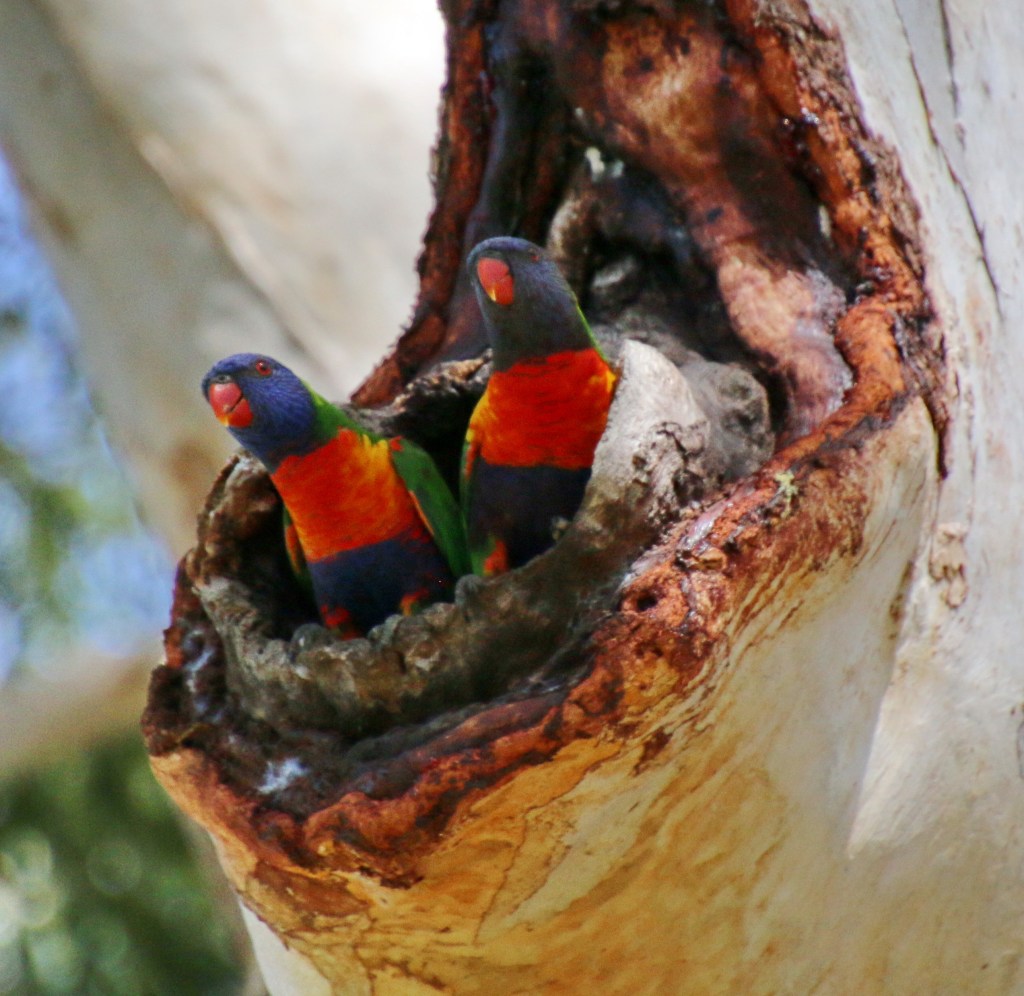
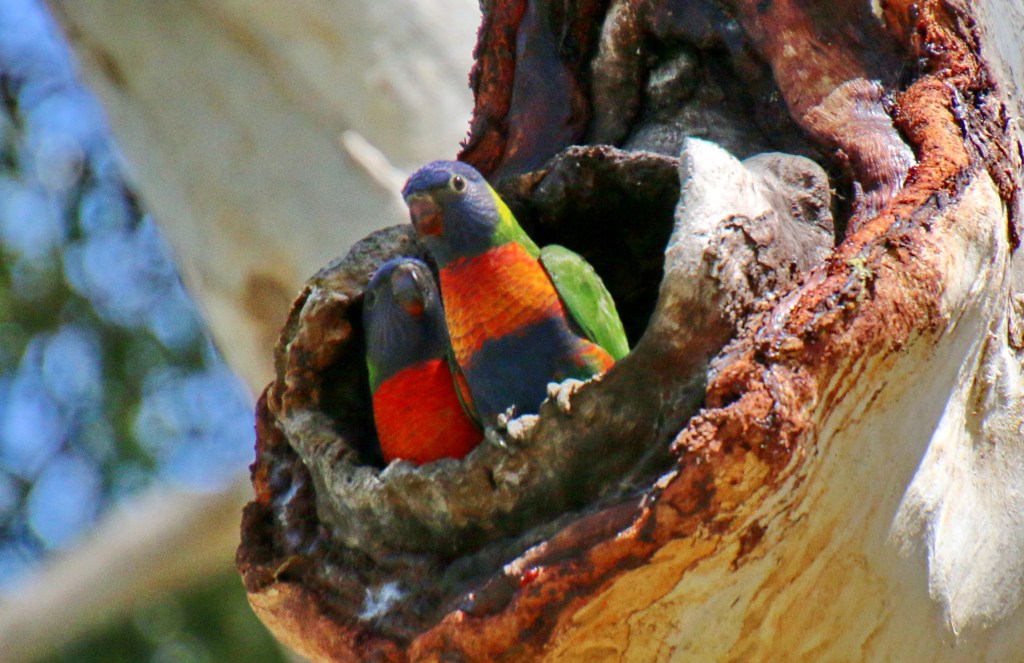
This week we will focus on two of our most colourful multi-coloured birds found here in the Summer months, both very different in most aspects except their beautiful coloured plumage. While the Rainbow Lorikeet lives, breeds and roosts in the Sydney Region and along the east coast of NSW, the Rainbow Bee-eater is a Summer Migrant, spending only the warmer summer months breeding in the dryer western areas of the coast. The Bee-eaters return to Far North Queensland and New Guinea during our Autumn. The Rainbow Lorikeet nests preferably in tree holes of the Angophora costata (Sydney Redgum) trees which are in plentiful here, where it competes with the Sulphur-crested Cockatoo.
Parents guarding nestTheir 2 juvenile nestings – note dark beaks
Lorikeets are also nectar feeders using their large wide tongue to flick the nectar from the native flowers of, Banksia, Grevillea, Bottlebrush and many species of Eucalypt, into their mouths. They also fed on native seeds and fruits. They are very noisy and raucous as they happily call and chatter to one another while they feed. These birds as well as the Bee-eater, pair for life and remain faithful to the one partner. You very rarely see a lone Lorikeet or Bee-eater. Here a Rainbow Lorikeet feeds on our Endeavour Bottlebrush flowers in our courtyard, They have been very noisy lately, that’s how we know there are flowers present, sometimes on the top of the tree. Click on images to enlarge them.
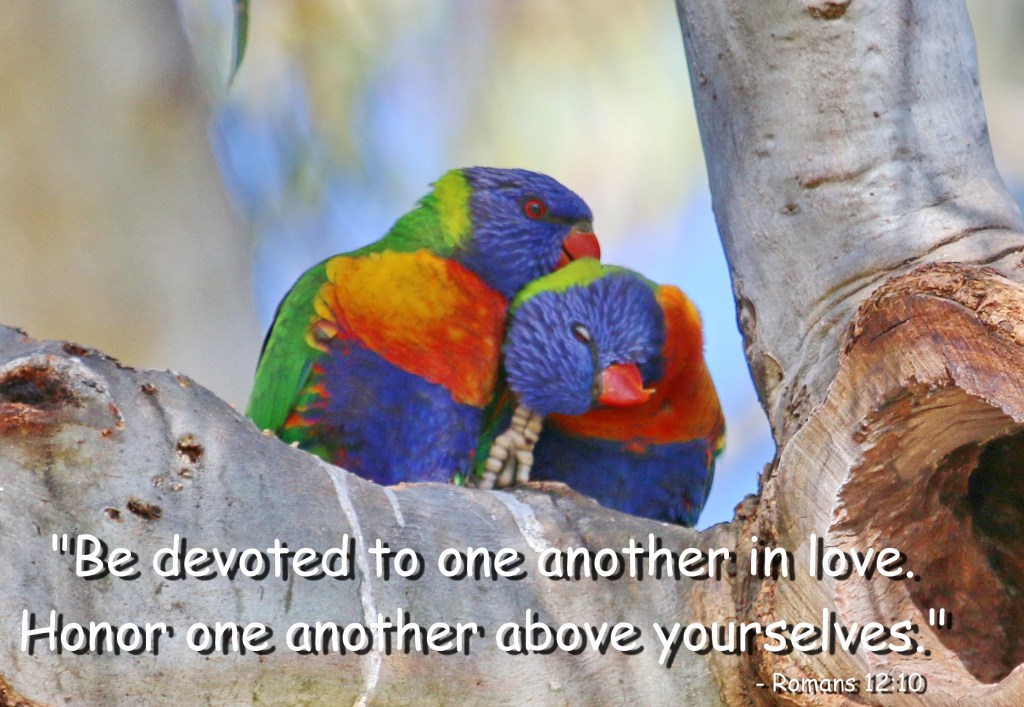
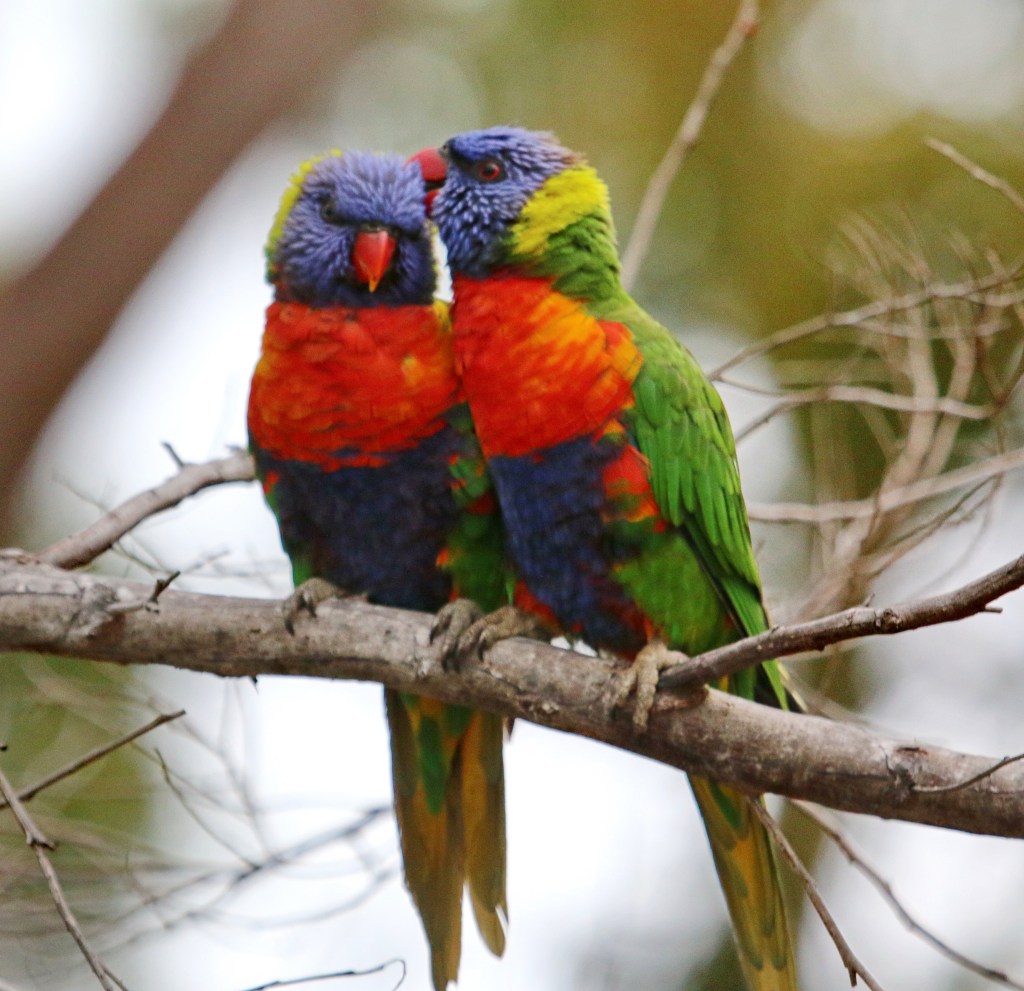
Pairs of Lorikeet are very devoted to the care and defense of each other and are often seen preening each other in difficult to get at places with expressions of ecstasy often seen on the face of the receiver. As a team they are known by other birds as a furious and painful bird to make conflict with, therefore most birds leave them alone.
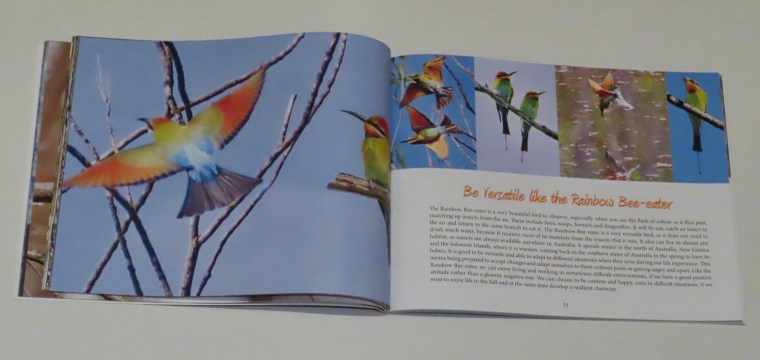
Both the Rainbow Lorikeet and the Rainbow Bee-eater are featured in my book “What Birds Teach Us” which is available here online and in NSW National Parks and Council Visitor Centres as well as the Broome Bird Observatory and O’Reilly’s Rainforest Retreat. Click on the image below to find out more.
The Rainbow Bee-eater feeds on bees, wasps and other flying insects which it catches on the fly, and returns to the branch from which it launched to consume it. They have an immunity to bee and wasp sting, whereas the Magpie has to manually remove the stinger before consumption. My wife and I were greatly blessed some years ago to trace the courting and mating ritual of the Bee-eater. Some of you will have seen this before. This is an improved version of the same video. Many bird species have a courting process that is preceded by the male offering a food gift to a resting female. Her reception of the gift or gifts, usually and respectfully will lead to a mate for life, and a new family soon to be formed. Nest or tunnel building usually begins soon after.
Similar to the Spotted and Striated Pardalote featured in last weeks post, Bee-eaters form their nests in tunnels they create in sand embankments, riverbanks and piles of soil. The tunnels can be from 50 to 100 cm long. These birds will often return to the same place each year to live out our summer, often quite dry hot areas, as these birds are quite adaptive in any environment as we saw in our visit to Broome, WA some years ago.
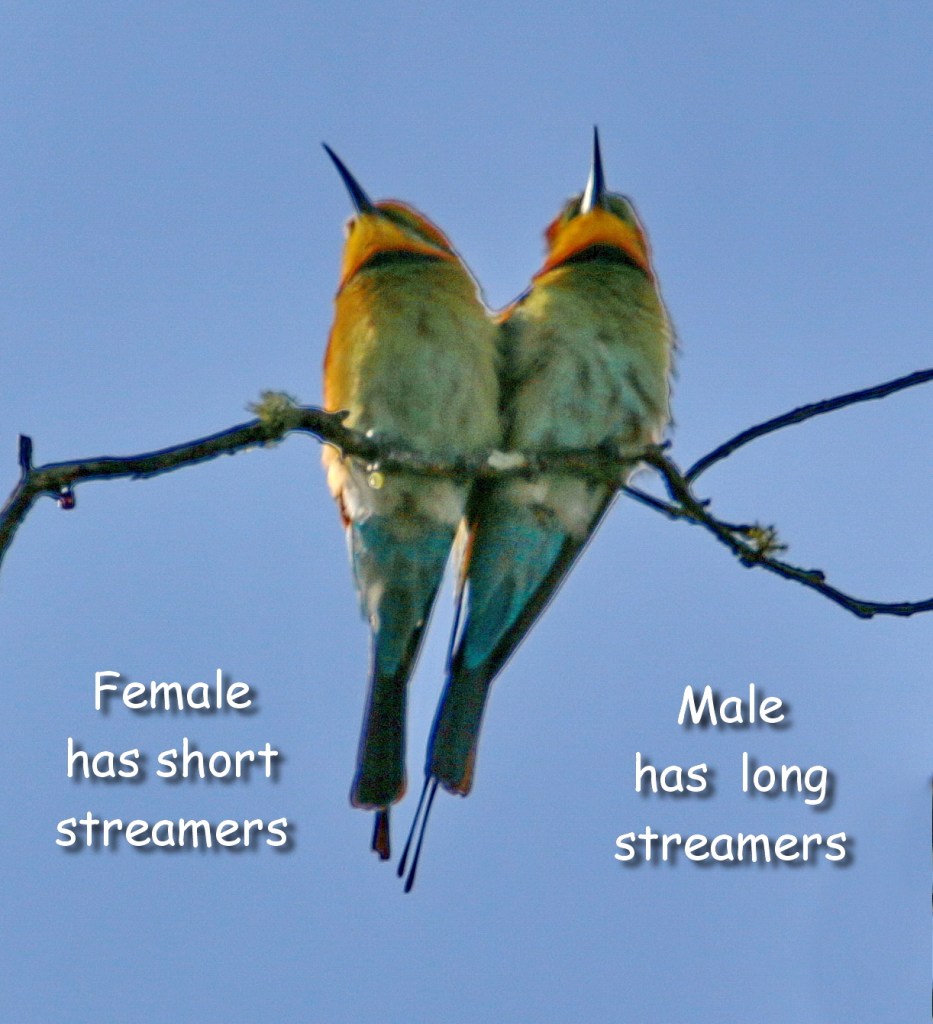
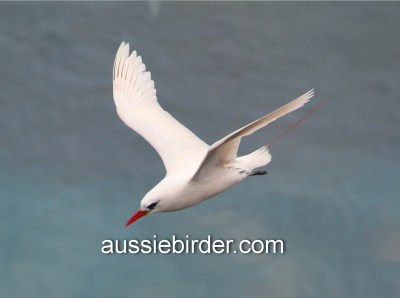
The sex can easily be discerned by the length of the streamer, which is the projection from their tail. The female has the very short thick streamers (one or two) and the male has the longer thinner streamers. Similar to the Red-tailed Tropicbird which also has tail streamers and performs aerial acrobatics during courting, these birds use the streamer to assist them in fast maneuvers when catching flying insects.
Rainbow Bee-eater calling
Enjoy your weekend and stay safe. My wife and I are in recovery from the terrible RSV virus that has infected many older people.
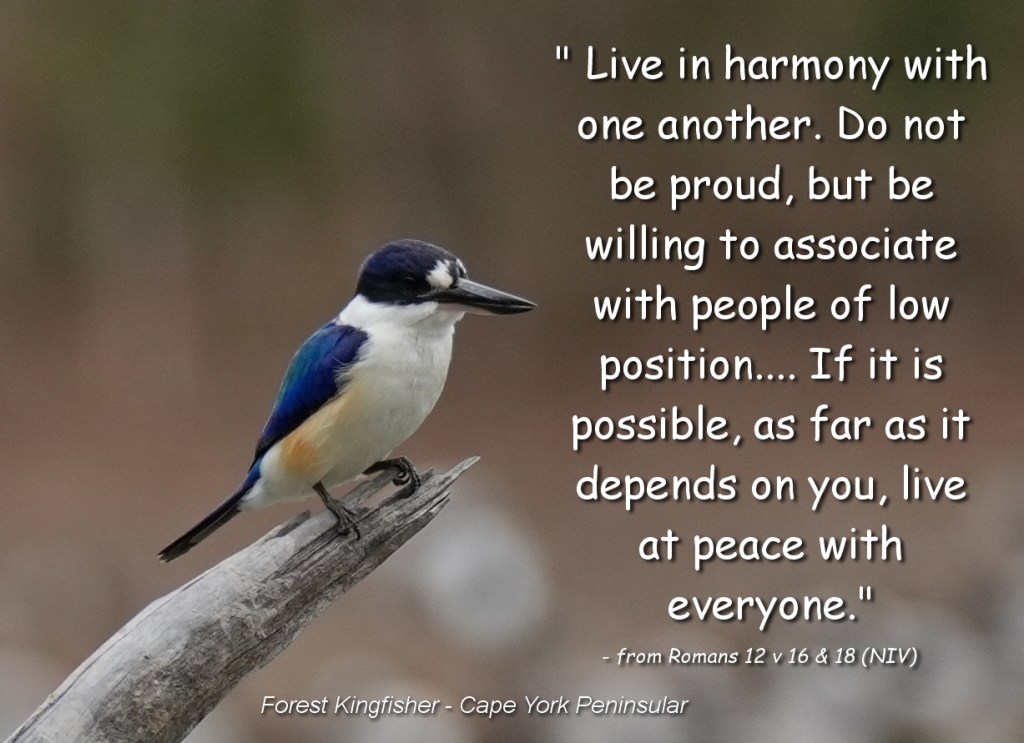
Both of these species of birds, share a faithfulness in their lifelong relationship with their partner, and a desire to selflessly care for the needs of the other as they live life together, preen and bring pleasure to each other. They will ruthlessly protect their partner from attacks mediated by other birds, together they will defend their common cause – their family. It is a good lesson to all young couples including older ones, as the increase in personal satisfaction and selfishness threatens a loving shared relationship when a person chooses to inconsiderably put their wants and desires above those of their partner.
My wife and I share a love of bird observing and bird photography which takes us all over Australia. We love sharing our experiences. Birds live in the beautiful parts of our country. We always get blessed with beautiful gifts of new birds and unexpected experiences each time we go out birding or just walking in the parks and reserves in our wonderful land. We love Australia, and the variety that each state and region offers in its wildlife and nature aspects. Join us in sharing our love. We have always found other birders enthusiastic and friendly people who appreciate the good things in life.
Thanks Donna, the Rainbows as pretty as they are are quite, energetic, noisy chattery birds which other birds will never take on due to the respect they have for their bite.
Thank you for sharing more of your beautiful birds, bright bursts of colour and joy.
We are very sorry to hear you and your wife have been ill – praying for a full recovery. You are in our thoughts always.
Thanks Takami, we have just returned from our anniversary weekend away at a luxury B&B in one of Australia’s top birding areas we have not visited for years. We are both recovering but the cough stays on making it challenging at night. Thanks to your precious prayers we are much better this week. Enjoy your week my friend.
Thanks Deborah, delighted you enjoyed the videos, the Bee-eater story is a special capture for us and we feel so blessed having seen it. We are taking longer than expected to be rid of the residual cough. So many people, especially older ones are suffering with this nasty virus here , and in Summer also ! The weather has been so bizarre the birds seem to have gone. We will see what we find when we go away to a different birding place for our anniversary weekend. Stay warm my friend.
Nice write up Ashley about two of our colourful native birds. I remember being amazed by seeing a few bee eaters many years ago when holidaying on K’gari Fraser Island. I would love to go back there one day and do some proper wildlife watching.
Frazer Island is an interesting place which we have done little birding on as we did not find many species when we visited it. I have not been able to make any sense of Peter Menkhorst’s addition of Aust Bird Guide of a dot in Tasmania near Hobart including Bee-eaters, as no one acknowledges them ever being there. They are found all over the mainland even in the hottest deserts, which is why I have them as great survivors and adapters in my book.
I use the Guide To Tasmanian Wildlife by Angus McNab which is fairly recent and there is no mention of bee eaters, not even as a vagrant, so I’d say that other book might be mistaken. It’s too cold for the bee eaters down here! 😀
Introduce your child to our amazingand interesting birds.Over 100 beautiful photos with facts on how they do life, from which we learn helpful life skills.Click image above to Find out more and Buy the Beautiful Bird Book
Teens and Young Adults
Flight of a Fledgling similar to my first book uses the interesting lives of birds to teach valuable life skills.It is written expressly for teens and young adults as they prepare to leave the Nest. It helps them to better understand themselves and improve their personal relationships and better prepare for lifes challenges.Click on the above cover to find out more and purchase online.
Stay and Explore the Rainforest in Lamington N P – click
Visit Broome Bird Observatory
Include in your next visit to Broome WA a couple of days on bird tours in Australia's Shorebird Capital at Broome Bird Observatory (BBO) in conjunction with Birdlife Australia, it is well worth it. Enjoy a self guided tour through their new and beautiful interactive discovery centre. Accommodation is available. Tours to various bird habitats: mangroves; bush and shoreline. BBO Wardens Sebastian and Jamie will make you welcome. While you are there check out the Beautiful Bird Book 'What Birds Teach Us'.
Help Save Our Birds
See Tasmania’s Endemic Birds
Luxury Stay in the Capertee Valley: bellebois.com.au
Where Can I Buy The Beautiful Bird Books?
How Do Birds Keep Their Nests Clean ?
Birding Around the Sydney Region
If you are a birder visiting the Sydney region for the first time, check out the many National Parks (NP) that surround it for the great variety of birds found there. The Visitor Information centres at The Royal NP, Botany Bay NP, Fitzroy Falls and Minnamurra NPs have information and also sell my Beautiful Bird Books. If you follow this blog, make a date with Aussiebirder before you arrive for info tips or a visit.







 aussiebirder
OMG these are so beautiful and cute.
LikeLiked by 1 person
Thanks Deepika, we do enjoy some beautiful birds, our Parrot family in particular are some of our most colourful.
LikeLike
Such amazing colors and coloring, Ashley! I so wish I had these in my backyard!!
LikeLiked by 1 person
Thanks Donna, the Rainbows as pretty as they are are quite, energetic, noisy chattery birds which other birds will never take on due to the respect they have for their bite.
LikeLiked by 1 person
Thank you for sharing more of your beautiful birds, bright bursts of colour and joy.
We are very sorry to hear you and your wife have been ill – praying for a full recovery. You are in our thoughts always.
LikeLiked by 1 person
Thanks Takami, we have just returned from our anniversary weekend away at a luxury B&B in one of Australia’s top birding areas we have not visited for years. We are both recovering but the cough stays on making it challenging at night. Thanks to your precious prayers we are much better this week. Enjoy your week my friend.
LikeLiked by 1 person
So stunning. I hope all is well with you.
LikeLiked by 1 person
Thanks Cindy, we are still in recovery but getting better daily.
LikeLike
They are all beautiful. The videos are wonderful, Ashley I enjoyed them all. I hope you and your wife get better soon!
LikeLiked by 2 people
Thanks Deborah, delighted you enjoyed the videos, the Bee-eater story is a special capture for us and we feel so blessed having seen it. We are taking longer than expected to be rid of the residual cough. So many people, especially older ones are suffering with this nasty virus here , and in Summer also ! The weather has been so bizarre the birds seem to have gone. We will see what we find when we go away to a different birding place for our anniversary weekend. Stay warm my friend.
LikeLiked by 1 person
Nice write up Ashley about two of our colourful native birds. I remember being amazed by seeing a few bee eaters many years ago when holidaying on K’gari Fraser Island. I would love to go back there one day and do some proper wildlife watching.
LikeLiked by 2 people
Frazer Island is an interesting place which we have done little birding on as we did not find many species when we visited it. I have not been able to make any sense of Peter Menkhorst’s addition of Aust Bird Guide of a dot in Tasmania near Hobart including Bee-eaters, as no one acknowledges them ever being there. They are found all over the mainland even in the hottest deserts, which is why I have them as great survivors and adapters in my book.
LikeLiked by 2 people
I use the Guide To Tasmanian Wildlife by Angus McNab which is fairly recent and there is no mention of bee eaters, not even as a vagrant, so I’d say that other book might be mistaken. It’s too cold for the bee eaters down here! 😀
LikeLiked by 2 people
I agree Sue, Bee eaters like it warm to hot but not cold.
LikeLiked by 2 people
Beautiful
LikeLiked by 1 person