Australian birds
Rainforest Secrets – The Australian Logrunner
The last few posts have featured some of our rather secretive rainforest birds which most Australians and many birders never get to see in the wild. Our very dense dark […]
Welcome to our website for the study and appreciation of Australian birds and their interesting behaviours.
The last few posts have featured some of our rather secretive rainforest birds which most Australians and many birders never get to see in the wild. Our very dense dark […]
The last few posts have featured some of our rather secretive rainforest birds which most Australians and many birders never get to see in the wild. Our very dense dark damp rainforest habitats have several birds that are equipped with protective plumage and behaviours that assist to make them safe from predation. We previously showcased the Bassian and Russet-tailed Thrush and the Green and Spotted Catbirds, all very secretive birds that blend in beautifully with their surroundings, However, there is an even more secretive rainforest bird which is probably the most furtive of them all, the Australian Logrunner. This very small bird spends all its life foraging in the deep leaf litter of the dark forest floor, making its detection extremely difficult. They have spurs on their very strong tails which they use for balance when digging with their very strong sturdy legs. The male has a white chest and the female a distinctive bright orange chest. They are only about 19 cm long with the males slightly larger.
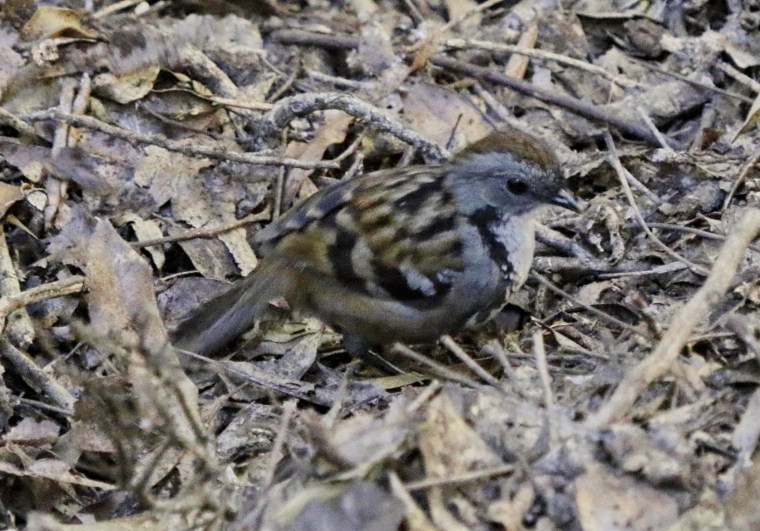

These little birds burrow down into the leaf litter using their legs and tail by kicking out the leaf litter ans disappearing down into a hole where they ingest worms and insects as they descend, all the while blending in perfectly with their surrounding environment. They remain still and motionless if they feel threatened, similar to the Thrushes and will walk away into the forest avoiding flight, as they seldom fly if they can help it.
While they are very difficult to spot visually in the rainforest due to their excellent camouflage, they can be heard calling loudly in their high pitched calls to one another. They are usually found in pairs because they pair for life and are fiercely territorial, defending their foraging area from other Logrunners. This male is calling to locate his female partner as he continues to forage in a choice feeding area, which maybe he wants to share with her.
Here is an example of the process they use to dig down below the deep leaf litter using their legs and spiny strong tail for balance. They will dig down out of sight as they eat the small worms and grubs they find after each kick. It is quite funny watching the leaf litter fly up and out of the holes when they are deep down inside and out of sight. The usual way they are discovered by birders when they are quietly foraging, is by hearing the sound of leaf litter being flung about as they dig down.
This bird was featured in the very first edition of my first book ‘What Birds Teach Us’ but I chose to withdraw it from the second edition, as it wasn’t a bird that people were likely to see in their birdwatching walks. However, those who have purchased the first edition 7 tor 9 years ago will know how I used it to teach that we are best to: ‘Choose What We NEED Rather than What We WANT.’ As this book has been out of print now for several years I will include it’s message below. If you click on the page from the book below you can learn more about this book which is much larger and up to date in its 2nd Edition. The page will open in a new tab.
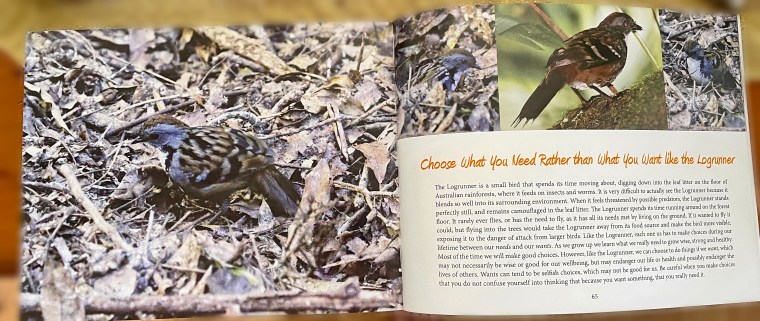
The Logrunner is a small bird that spends its time moving about, digging down into the leaf litter on the floor of Australian rainforests, where it feeds on insects and worms. It is very difficult to actually see the Logrunner because it blends so well into its surrounding environment. When it feels threatened by possible predators, the Logrunner stands perfectly still, and remains camouflaged in the leaf litter. The Logrunner spends its time running around on the forest floor. It rarely ever flies, or has the need to fly, as it has all its needs met by living on the ground. If it wanted to fly it could, but flying into the trees would take the Logrunner away from its food source and make the bird more visible, exposing it to the danger of attack from larger birds. Like the Logrunner, each one us has to make choices during our lifetime between our needs and our wants. As we grow up we learn what we really need to grow wise, strong and healthy. Most of the time we will make good choices. However, like the Logrunner, we can choose to do things if we want, which may not necessarily be wise or good for our wellbeing, but may endanger our life or health and possibly endanger the lives of others. Wants can tend to be selfish choices, which may not be good for us. Be careful when you make choices that you do not confuse yourself into thinking that because you want something, that you really need it.
Have a wonderful week and enjoy your local birds. The weather has not been good for birding here with storms and humidity and Cicadas.

Notice the large tail spines to give stability to the Logrunner while it is actively digging as it falls back on its tail to allow it to kick and flick out the leaf litter.
I learnt from my first class in Economics at high school, The Economic Problem, which states that: There are limited resources but unlimited wants. It is a mismatch which will always be a problem for humankind, especially a selfish and sinful humankind. There is such a disparity between needs and wants. So many in the world need the basics of food and shelter and clean drinking water, yet we in the wealthy west can afford to have wants as well as needs and waste so much of what others need, simply because we can and do. It is also why people become unhealthy due to over indulgency and addictions. Always wanting more, but it does not satisfy. The other economic problem kicks in: The Law of Diminishing Returns which states one’s enjoyment and satisfaction depreciates with each additional repeat of the same process or ingestion. That first mouthful is always the very best, we savour, but not usually the ones that follow.
The wonderful assurance is that our Creator God wants to be needed by us. He longs for intimate relationship with the people he has created for his own pleasure. He wants us to rely on him who gives us life and all things that pertain to it freely and unconditionally, which is the nature of his love. The rain falls on the roof of the good and the bad. When we get this right we start to want what need rather thank selfishly feel we need what we want. This is why Jesus said these words:
“And do not set your heart on what you will eat or drink; do not worry about it. For the pagan world runs after all such things, and your Father knows that you need them. But seek his kingdom, and these things will be given to you as well.” – Luke 12:29-31 (NIV)

Adv. Dip. in Counselling and Family Therapy.
Member of Birdlife Australia
To introduce people to our unique Australian birds,
And learn from them how to live a healthy and happy life.
NOTE: All photos, videos and music used on this website are photographed, composed, performed by the site owner and remains his copyrighted property, unless otherwise stated. The use of any material that is not original material of the site owner is duly acknowledged as such. © W. A. Hewson 2015, 2016, 2017, 2018, 2019, 2020, 2021, 2022, 2023, 2024, 2025, 2026

My wife and I share a love of bird observing and bird photography which takes us all over Australia. We love sharing our experiences. Birds live in the beautiful parts of our country. We always get blessed with beautiful gifts of new birds and unexpected experiences each time we go out birding or just walking in the parks and reserves in our wonderful land. We love Australia, and the variety that each state and region offers in its wildlife and nature aspects. Join us in sharing our love. We have always found other birders enthusiastic and friendly people who appreciate the good things in life.
 Introduce your child to our amazing
and interesting birds.
Over 100 beautiful photos with
facts on how they do life, from
which we learn helpful life skills.
Click image above to Find out more and Buy the Beautiful Bird Book
Introduce your child to our amazing
and interesting birds.
Over 100 beautiful photos with
facts on how they do life, from
which we learn helpful life skills.
Click image above to Find out more and Buy the Beautiful Bird Book

Flight of a Fledgling similar to my first book uses the interesting lives of birds to teach valuable life skills.It is written expressly for teens and young adults as they prepare to leave the Nest. It helps them to better understand themselves and improve their personal relationships and better prepare for lifes challenges. Click on the above cover to find out more and purchase online.



 If you are a birder visiting the Sydney region for the first time, check out the many National Parks (NP) that surround it for the great variety of birds found there. The Visitor Information centres at The Royal NP, Botany Bay NP, Fitzroy Falls and Minnamurra NPs have information and also sell my Beautiful Bird Books. If you follow this blog, make a date with Aussiebirder before you arrive for info tips or a visit.
 aussiebirder
Hi Ashley. Running this of the iPad so hope it works well
Fascinating to see how well the can burrow underneath the leaf litter. Often wondered how they were named. But as they would rather scamper about than fly it makes sense
LikeLiked by 1 person
Thanks David, so sorry you have had so much trouble navigating mt Comments, I am also having problems with WP. I wish they would just leave things alone. ‘If it ain’t broke, it don’t need fix’n’. My very first Logrunner sighting was seeing it run along a fallen log in the rainforest. At that time I had no idea what it was.
LikeLike
What a QT!
LikeLiked by 1 person
Thanks Cindy, yes they are very cute little guys.
LikeLike
That is definitely a new bird for me, thanks for the introduction.
LikeLiked by 1 person
Thanks Doerfpub for your welcome comment, yes these are very secretive birds most never get to see,
LikeLiked by 1 person
A very beautiful bird! I do remember being introduced to this bird through your lovely bird book, but always exciting to learn more about them. Thank you for sharing this secret with us 🙂
LikeLiked by 1 person
Thanks Takami, yes you would have seen this bird in the first edition, which is now a collectors item 🙂 as it no longer is available. These birds are so secretive and often go un noticed as they freeze from movement if they hear any noise nearby, and blend so beautifully into their surroundings. I hope you are both enjoying your time away.
LikeLiked by 1 person
That’s a neat bird and beautiful as well! The videos are wonderful, Ashely. I hope you have a lovely week-end!
LikeLiked by 1 person
Thanks so much Deborah for your appreciative comment. They are amazing little birds when one gets to see them. Have a wonderful weekend also my friend.
LikeLiked by 1 person